Beatriz's grief after her mother's death
Gente que viene y ¡Bah!Beatriz's grief after her mother's death is marked first by shock, then by the discovery that mourning cannot be separated from family, memory, and the difficult prospect of carrying on. Ángela's death leaves Bea feeling orphaned and unable to imagine a life without her; her mother's notebook and Diego's hard-won understanding of bereavement become points of contact with a future that still feels almost impossible.
The news and the first hours of grief
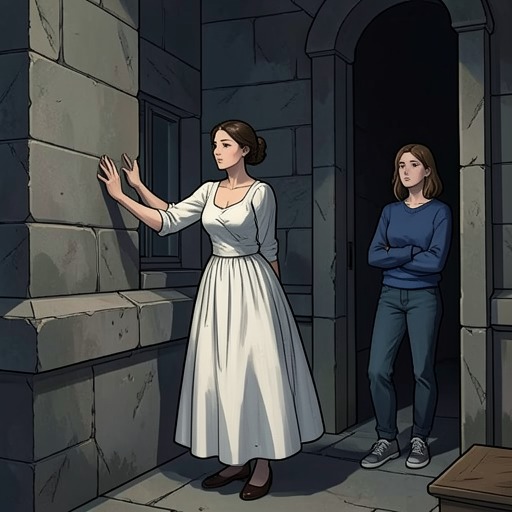
Irene tells Bea that their mother has just died. When Bea reaches the family home, she pauses at the door with the key still on her key ring, unable to find the strength to put it in the lock. Irene opens it herself, gaunt with grief, and embraces her sister in tears. Bea cannot yet cry. The contrast between Irene's sobbing and Bea's numbness makes the first response to the news less a release than a stunned inability to take it in.
The family gathers at the house: Fin, León, Jacobo, Débora, and their father arrive, while visitors from across the community come to pay their respects. Bea sees Ingrid among them. The crowd is a source of support, but it does not erase the loss; it surrounds the first hours in which the family must begin to accept that Ángela is gone. The death also has a particular setting in the family’s memory: León and Bea’s father found Ángela unconscious over the kitchen table, called an ambulance, and discovered that she had stopped breathing. Bea is relieved not to have been the one to find her mother that way, while recognizing that she could not have borne the sight.
It is her father’s embrace that finally breaks through Bea’s numbness. She releases Irene and goes to him, then sobs without restraint. His arms briefly soften the vast emptiness and senseless cold she has felt since the previous day. When he calls her his little girl rather than an architect, the change of address captures how bereavement has unsettled her adult identity: in that moment, she feels helpless and orphaned. The comfort is real but temporary; it does not make the absence comprehensible.
The notebook and the continuing bond
After the wake, cremation, embraces, and condolences, Bea withdraws to her childhood bedroom with Ángela’s red notebook, Libreta roja de Hello Kitty. Her mother had been writing when she died, and the notebook’s cover bears Bea’s name. Bea had been told that she might read it one day; now the pages are what her mother has left specifically for her. Before opening it, she hugs the notebook, treating the object as a last available form of closeness.
The time Bea spent at home gains a painful new meaning as she looks back on it from the room where she had passed much of the spring. Her earlier troubles now seem small beside her mother’s death, but she is grateful that she had been there with Ángela and the rest of the family. Bea recognizes the chain of events that brought her home: Víctor and the TV News Presenter had helped set those events in motion. What had been painful and disruptive also gave her time with her mother. That recognition does not diminish the present grief; instead, it holds gratitude and devastation together, making the earlier misfortune look different without making this loss any less severe.
The family learns that Ángela had known for months that her heart would not hold out much longer. Tests had given her that knowledge, although she did not know how much time remained. She had kept it from her family not simply to preserve a secret, but in the hope that not saying it aloud might keep it from happening. Her notes were a precaution against the possibility she could not name openly. Their existence means that, after death, Ángela can still address her family in her own words.
As Bea reads aloud to Débora, Ángela tells her daughter that she has inherited her gift of empathy but does not demand that she continue the family practice. She accepts Débora’s work as a photographer, praising the photograph of Teodoro with Óscar and describing art as another way of empathizing with others. The notebook is therefore not only a record of impending loss: it carries Ángela’s recognition of her daughters and permission for them to choose their own lives. Later, a note about Bea and her sisters prompts the family to see the death as having helped bring them back into accord. In this way the writing keeps Ángela involved in the family’s relationships even as the family gathers without her.
Ritual, family, and absence
Ángela’s notes also specify where she wants her ashes scattered: at the sea cliff where Irene had arranged for the Romanesque chapel to be moved. The place had been one of Ángela’s favorites, and she had joked that the chapel had turned it into a pilgrimage site. The family goes there two days after the funeral. Although they had intended a private family farewell, many people come after hearing the news; they do not refuse them, because Ángela would have liked their company and the family still draws comfort from being surrounded by others.
The October sky is cloudless and the sea calm. Bea had spent the previous night imagining the northern wind blowing her mother’s ashes back over the family. Instead, they fall into the water and disappear over the waves. The concrete act of scattering gives the family a shared task and a place to gather, but the ashes’ disappearance also makes the permanence of death visible. The ritual offers no return and no final explanation; it gives grief a form the family can enact together.
Diego’s offer and the possibility of continuing
The depth of Bea’s grief becomes explicit when she is alone with Diego in his car. The familiar smell of the leather seat makes her break down, and she tells him she cannot live without her mother. She asks how he managed to live after his wife died, naming the problem not as sadness alone but as an inability to grasp that her mother no longer exists and can never be seen again. Diego does not answer immediately. He drives in silence for a couple of kilometers, giving her space to release some of what she is feeling, or perhaps because he does not know what to say.
Before Bea gets out, Diego admits that he does not know how he survived his own loss. He says he did badly and spent more than two years making mistakes, but believes he has finally learned something; if Bea wants, he will help her. His response offers no tidy method for grief and no claim that it can be done well. Its force lies in the honesty of someone who has lived through bereavement without mastering it. Bea is moved and realizes that she wants his help, because it may be the one thing that enables her to continue.
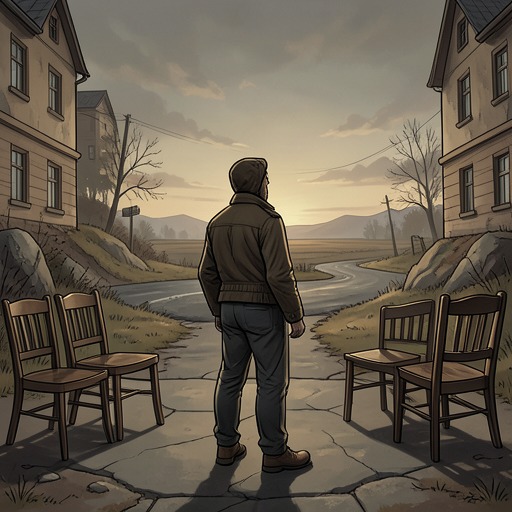
Diego leaves the car and walks among the chestnut trees; Bea follows him into the forest, where he stops in a clearing. The scene ends not with grief resolved, but with Bea accepting the possibility of being accompanied through it. Across the notebook, the family gathering, the scattering of ashes, and Diego’s offer, mourning is portrayed as a continuing relation rather than a clean severance: Ángela remains present through what she wrote and the time she shared with her daughters, while the living begin, tentatively, to support one another without pretending the loss has become bearable.